Budapest Fire Rated Glass Solutions: Certified for Hungarian MSZ EN Compliance

Budapest's architectural landscape, from the historic Castle Hill district to the modern developments in Pest, demands a sophisticated approach to passive fire protection. Compliance with the Hungarian MSZ EN 13501-2 standard is non-negotiable for building permits and safety certifications. Antifires provides certified fire rated glass solutions that align precisely with these localized regulations, ensuring that every installation—whether in a heritage renovation or a new commercial tower—meets the required fire resistance classifications. The Hungarian National Fire Protection Directorate (OKF) mandates rigorous testing for integrity (E) and insulation (I), often requiring ratings up to 120 minutes for partition walls and egress routes. By integrating 120-minute fire rated glass systems into project specifications, architects and contractors can achieve both safety and local approval. For a deeper understanding of the European classification framework, refer to the official European Commission guidelines on fire resistance standards. Antifires’ pre-certified assemblies eliminate guesswork, providing a direct path to compliance for Budapest’s diverse building projects.

Hungarian MSZ EN 13501-2 Fire Resistance Requirements for Budapest Building Renovations

Budapest’s historic building stock, particularly in protected zones like Castle Hill and the UNESCO-listed Andrássy Avenue, requires careful retrofitting to balance preservation with modern fire safety. The MSZ EN 13501-2 standard classifies fire resistance based on integrity (E) and insulation (I), with many partition walls in these renovations needing ratings of EI60 or EI120 to prevent fire spread between compartments. For example, upgrading a 19th-century apartment block on the Buda side often involves installing fire-rated glazing that maintains the original aesthetic while providing up to 120 minutes of fire separation. The use of EI60 fire rated glass in partition walls is a common specification, as it offers sufficient protection for escape routes without compromising the building’s historical character. Technical challenges, such as adapting modern steel frames to older masonry openings, are addressed with ceramic wool seals and intumescent fire strips, ensuring the assembly meets the stringent test conditions of BS EN 1364-1. This localized approach guarantees that Budapest’s heritage structures achieve the required fire resistance without sacrificing architectural integrity.

Selecting EI30 to EI120 Fire Rated Glass for Budapest’s Mixed-Use Construction Projects

New commercial developments in Budapest’s District V, including open-plan offices and mixed-use towers, demand fire-rated glass solutions that compartmentalize spaces effectively. Local fire codes often specify EI30 to EI120 ratings to control fire spread in stairwells and vertical shafts, where the stack effect can accelerate flames. For instance, a 15mm FPOS glass assembly, certified for integrity up to 132 minutes and insulation for 33 minutes, provides robust protection in high-traffic corridors. The selection of the appropriate rating depends on the building’s height and occupancy: EI30 is typically sufficient for low-rise commercial partitions, while EI60 or EI120 is required for high-rise escape routes. Antifires’ multi-layer glass structures, such as the 28mm EI60 panel (66 minutes integrity, 64 minutes insulation), are engineered to maintain thermal insulation under furnace conditions, with temperature rises controlled to a maximum of 180°C on the unexposed side. This performance ensures that open-plan layouts remain safe, with fire-rated glazing acting as a reliable barrier during evacuation.

Application of Fire Rated Glass in Budapest’s Commercial Corridors and Cultural Landmarks

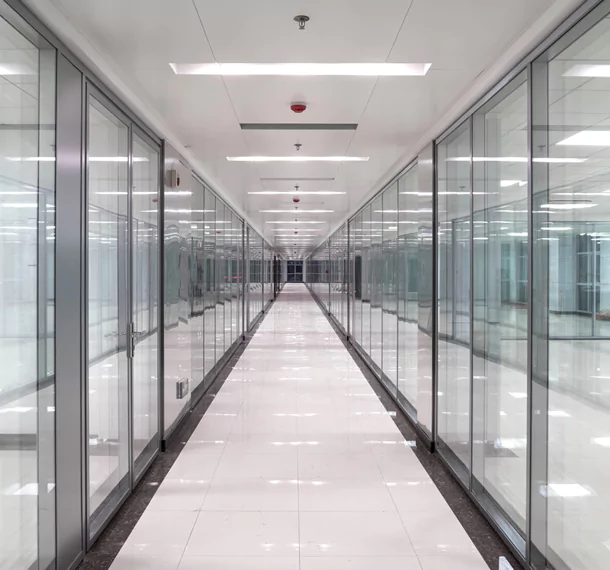
Budapest’s commercial corridors, such as Váci Street and the retail hubs around Deák Ferenc Square, require fire-rated glass solutions that facilitate pedestrian flow while meeting egress safety standards. Fire-rated doors and windows in these areas must provide at least 30 minutes of fire separation to comply with MSZ EN 1634-1 criteria, which govern door and shutter assemblies. For example, a 26mm glazed door glass, certified for 89–90 minutes integrity and 68 minutes insulation, offers a high-performance option for shopfronts and mall entrances. The key challenge in these high-traffic zones is balancing visibility with fire resistance: multi-layer glass with intumescent gel layers ensures that the assembly remains transparent while preventing flame penetration. Additionally, the use of 6mm E90 glass (90 minutes integrity) in corridor partitions allows for uninterrupted sightlines, which is critical for wayfinding in retail environments. By specifying 90-minute fire rated glass for doors and windows, developers can meet both aesthetic and safety requirements, ensuring that egress routes remain clear and compliant with local regulations.

Antifires’ Localized Engineering Support and MSZ Certification for Budapest Buyers

Antifires provides comprehensive engineering support for Budapest buyers, including pre-certified assemblies that align with MSZ EN 13501-2 test reports. This eliminates project delays by ensuring that all fire-rated glass systems are directly approved by the National Fire Protection Directorate (OKF). The technical documentation includes detailed frame specifications—such as G.M.S. hollow steel sections with 12mm to 15mm fire-rated insulation boards—and installation protocols that account for expansion gaps (3mm to 5mm) filled with ceramic fiber. For contractors, this means that on-site adjustments are minimized, as the entire assembly has been tested under standard conditions (e.g., ambient temperatures of 27°C to 36°C and relative humidity up to 90%). Antifires also offers localized guidance on fixing anchor bolts (M6 or M8, spaced 300–600mm) and integrating intumescent fire seals (20mm × 4mm) to maintain the assembly’s integrity. This end-to-end support ensures that Budapest projects achieve compliance without unexpected costs or delays, reinforcing the reliability of Antifires’ solutions in the Hungarian market.

REQUEST A QUOTE

Fill the form below to get in touch with us.

click

Frequently Asked Questions (FAQ)

Yes, all Antifires fire rated glass assemblies are tested and certified to meet the MSZ EN 13501-2 standard, which is the Hungarian adoption of the European fire classification system. This standard classifies products based on integrity (E) and insulation (I) performance, ensuring compliance with local building permit requirements. Antifires provides detailed test reports from accredited laboratories, such as those conducted under BS EN 1634-1 and BS EN 1364-1, which are recognized by the National Fire Protection Directorate (OKF) in Budapest. For example, the 21mm FPOS glass offers 120 minutes integrity and 30 minutes insulation, meeting the EI30 classification often required for partition walls. This documentation eliminates the need for additional local testing, streamlining the permit approval process for Budapest contractors.

For Budapest office building partitions, the most commonly specified fire resistance rating is EI60, which provides 60 minutes of both integrity and insulation. This rating is typically required for compartment walls in open-plan offices and corridors, as it allows sufficient time for evacuation and firefighting. In higher-risk areas, such as stairwells or vertical shafts, EI120 may be specified to prevent fire spread between floors. For example, the 28mm EI60 panel (66 minutes integrity, 64 minutes insulation) is a popular choice for office partitions, while the 50mm EI120 glass (120 minutes integrity and insulation) is used in critical escape routes. The selection should be based on the building’s height, occupancy, and fire risk assessment, with Antifires offering pre-certified solutions for each classification.

Yes, Antifires provides comprehensive localized technical documentation and on-site installation support for Budapest projects. This includes pre-certified test reports under MSZ EN 13501-2, detailed frame and sealant specifications (e.g., ceramic wool with 210 kg/m³ density), and installation guidelines for anchor bolt spacing (300–600mm) and expansion gaps (3–5mm). Antifires’ engineering team can also offer remote or on-site consultation to address specific project challenges, such as retrofitting historic buildings or integrating fire-rated glazing into modern steel frames. This support ensures that contractors achieve direct compliance with OKF approvals, minimizing delays and ensuring the fire-rated assemblies perform as certified under standard test conditions.